

West End Church is part of the oldest continually worshiping Protestant church in America.
History
We trace our origins to a loft above a gristmill in New Amsterdam in 1628. Dutch settlers worshiped there before the first permanent church was built in 1642. The millstones from that mill can be seen in the vestibule of our church.
The Collegiate system dates from 1652, when Johannes Megapolensis was minister. At this time the duties became too heavy for one man and an assistant was called. The assistant was named a colleague, hence the name “Collegiate.” We remain part of the Collegiate Church of New York, the oldest continually worshiping Protestant church in America. Distinct in character but unified in mission, our sister ministries are Middle Church in the East Village and Marble Church in NoMad.
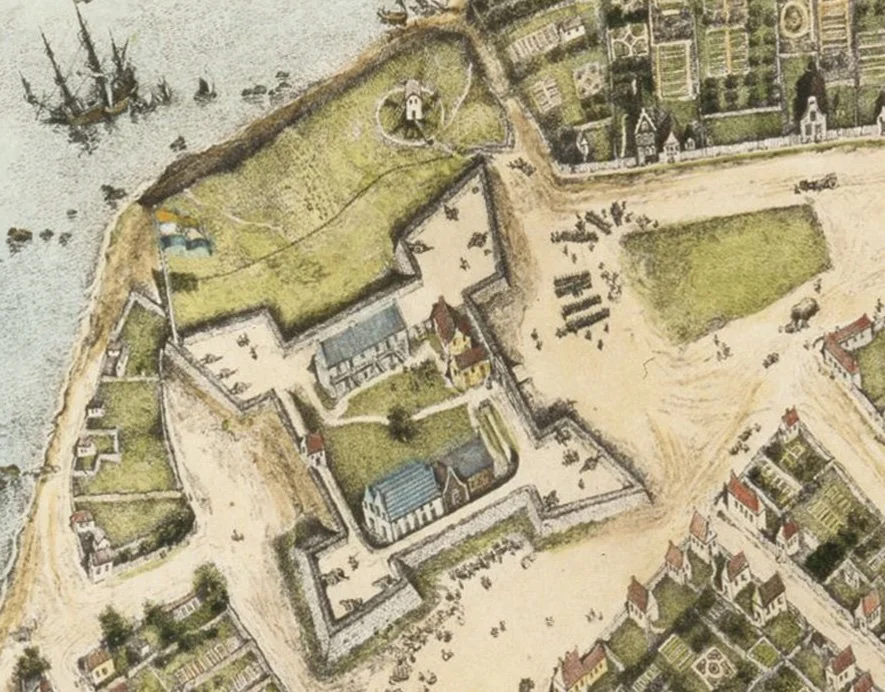
Our history is a long and colorful one. Although Dutch in origin, the Reformed Church in America (RCA) has, since its very first days, been multi-lingual and multi-ethnic. It was founded 150 years before the Revolutionary War. The word “Reformed” comes from the Protestant Reformation, which swept across Europe in the 1500s under the leadership of such men as Martin Luther and John Calvin. Calvin’s reformation at Geneva spread to many European countries, and immigrants to America brought Reformed theology with them. The most famous American mainline denomination with Reformed roots is the Presbyterian Church. Here at West End, we keep this tradition in mind with the motto “reformed and always reforming”: holding ourselves to a thoughtful, self-examining and active faith that inspired the Reformers half a millennium ago.
In November 2024, the members of West End voted to affiliate solely with the UCC, having found it to be a strong denominational partner with theology and governance that allows us to live into our unique history, progressive values, and local character. Although we are no longer affiliated with the RCA at a congregational level, the Collegiate Church central organization maintains that affiliation and we remain deeply proud of our Dutch heritage, as well as our foundational role in the early history of New York City.
When and by whom was West End Collegiate Church founded?
In the decade prior to the building of West End Collegiate Church, the West Side, formerly farmland, experienced a building boom and surge of population, beginning with the opening of the Dakota Apartments in 1884. There were few churches in the area, and many residents continued attending church downtown or on the East Side.
On October 16, 1890, the Consistory of the Collegiate Church instructed the "Committee on a new church site west of Central Park" to price several plots of land of at least seven lots. By January of 1891 the Committee reported that they had contracted for four lots on West End Avenue and an adjacent three lots on 77th Street for $89,000. A new committee was formed to present plans for a church, chapel and school on the site. Building began in 1891 and was completed in the fall of 1892. Today West End Collegiate Church and Collegiate School share the site and a history of mutual support and growth.
On November 19, 1892, The Reverend Henry Evertson Cobb of West Troy, New York was called to become the first minister of West End Collegiate Church. Our current pastor is The Reverend William H. Critzman. He is only the sixth pastor in the history of West End.
A Beautiful Historic Building
As the West Side expanded, criticism was made of the lack of uniformity, and developers were urged to keep the character and scale of a group of buildings similar. The Romanesque style had become overused, and the architectural firm of McKim Mead & White, attempting both to attract old Knickerbocker families and to give the community a sense of history, initiated a revival of the Dutch Colonial style on the Upper West Side. Many buildings on West End Avenue and side streets were built in this style. The design of West End Collegiate Church was chosen not only to reflect the Dutch history of the Collegiate Church, but because it was part of an urban trend at the time. Architect Robert W. Gibson styled the church after the 1606 Vleeshal in Haarlem, The Netherlands.
The church yearbook of 1893 describes the new building:
The style of architecture is Dutch, modeled upon the old buildings of Haarlem and Amsterdam. This style has the picturesque qualities of the Gothic, with more originality, and is historically appropriate. The materials used are long, thin bricks of a Roman pattern and brown in color, trimmed freely with quoins and blockings of buff terra cotta. Some very picturesque panels carved with the coats-of-arms of the church and of past benefactors are also in terra cotta. The pulpit is large and of octagonal shape. Its handsome base is of carved oak, the panels showing the coat-of-arms of the Reformed Church and the seal of the Church. The carved oak pulpit chairs are rich examples of the Old Dutch style. (Decoratively the church is actually Renaissance Revival in style.)
In the large circular window in the south gable of the church is placed an armorial window which exhibits the armorial bearings of the various Dutch Provinces forming the Union of Utrecht, also the heraldic symbols of the United States and the State and City of New York, thereby setting forth the common origin and union of the parent stem and American branch of the Collegiate Church.
Over the next several decades, contributors donated the various windows we see today, three of which are from the Tiffany studios.